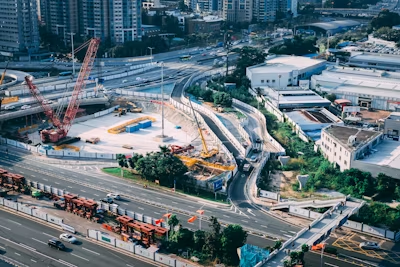
The construction world is no longer what it once was. Do you remember the old pictures – helmets, rolled up blueprints, cranes pulling steel beams skyward, slowly day after day? That era is fast disappearing. Today, the industry is being reinvented from the ground up, driven by two powerful forces: cutting-edge technology and the real urgency to build more sustainably. outcome? Projects completed faster keep workers safer and have less impact on the planet.
But it’s not just about replacing old devices with shiny new devices. Let’s take a look at ten key trends driving this change in modern construction.
This version keeps your core message intact and makes it feel like a story told by a real person—someone who’s excited about the future of manufacturing, not just reporting on it.
Table of Contents
1. The Rise of the Digital Twin: Building Before Building
Imagine this: Before pouring a single foundation, you can test how sunlight will heat a lobby in winter, simulate how an audience will move through a concert hall during an emergency evacuation, or capture a collision between a pipe and a wire that could cause a week-long delay on site. With a digital twin, you solve problems on the screen – not in the workplace – and save time, money, and headaches.
And the best part? The work does not end when the building opens. That same digital twin hovers around, helping facility teams fine-tune heating and cooling, better schedule maintenance, and plan renovations with confidence. It’s like giving each building a digital conscience—one that continues to learn, adapt, and look for its real-world counterpart.
2. Modular and Prefabricated Construction: Precision in a Factory
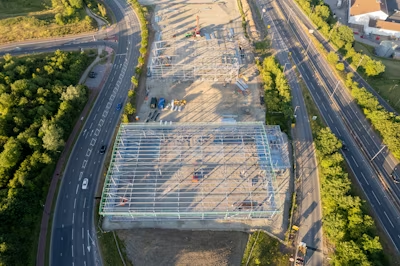
One of the biggest changes reshaping construction today? We take most of the work out of the mud and rain to the factory. Instead of building everything piece by piece on site, teams now build walls, rooms, and even entire building sections indoors under controlled conditions. These modular or prefabricated components are then carefully shipped to the site and assembled like high-tech Lego bricks.
The impact is enormous. We no longer have to wait for weeks for the rain to stop. Fewer surprises, as quality checks take place in a clean, consistent environment. Less wasted material, because factories can cut and plan orders with surgical precision. And contrary to old notions, it’s not just for sheds or cheap accommodation – imagine entire hospital wings or elegant urban high-rises, growing faster and more reliably thanks to smart off-site construction.
In this new vision, construction sites begin to look less like chaotic battlefields and more like calm, choreographed assembly lines. outcome? Projects are completed faster, teams work with greater security, and everyone from architects to business people can breathe a little easier.
3. Building Information Modeling (BIM): The Collaborative Backbone
You’ve probably heard of BIM – building information modeling – but it’s no longer just a handy 3D drafting tool. These days, it’s the connective tissue of a construction project: the shared digital space where architects, engineers, contractors, and even owners all come together, working on the same live, up-to-date model.
What makes BIM very special is that it transforms collaboration from something we hope for to something that just happens. No frantic email chains over old plans. No more coming to a place only to see steel beams where the ductwork will go. With BIM, if a structural engineer moves a column, the mechanical engineer sees it immediately – and can reroute the channel before any equipment gets caught.
Finally, BIM is not only changing the way we build buildings. It changes the way we build them – better, smarter, and together.
4. The Green Revolution: Sustainable and Regenerative Construction
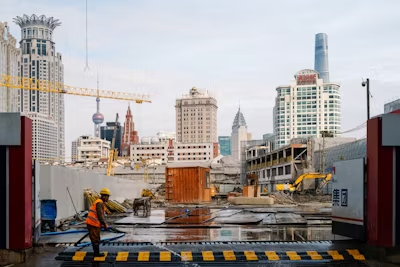
There is no escaping it: the way we create shapes the world we live in – and right now that world needs our help. A quiet but powerful green revolution is therefore gaining momentum in the construction sector. Sustainability is no longer just a buzzword or luxury add-on; This is becoming the new standard, driven by both necessity and care for the planet and for the people who live in these places.
Today’s builders think differently at each step. They design zero-energy buildings that give back as much as they take – powered by sun, wind, or other renewable energy, so they leave no carbon debt. They choose materials with discretion: recycled steel from old cars, reclaimed wood with decades of character, and even futuristic, earth-friendly options like mycelium-grown hemp concrete or mushroom-based insulation.
Water is also considered a valuable resource. Smart systems now collect rainwater for irrigation or recycle dirty water from sinks and showers – and turn waste into something useful.
And perhaps most inspiring is the rise of regenerative design: buildings that don’t just ‘do less harm’, but actually do good. Imagine rooftops blooming with native plants that feed bees and birds, or walls that clean the air. These are not sci-fi dreams – these are real projects happening now.
5. Robotics and Automation: The Future of the Jobsite
Robots are not just coming – they are already in the workplace. And they are not here to replace people, but to help them. From brick bots that tirelessly drive course after course, to self-propelled bulldozers that grade land with almost surgical precision, to drones that silently hover above and map the terrain – machines step in where work is dangerous, mundane, or requires superhuman precision.
And honestly? They come just when the industry needs them most. By taking on the most difficult tasks, robots help keep human crews safe and allow them to focus on the efficient, thoughtful work they do best.
In addition, these machines do not get tired or turn over. They work consistently, accurately, and often faster – meaning projects move more smoothly with fewer errors and higher quality results.
In short, robots don’t make construction colder or impersonal—they make it smarter, safer, and more sustainable for the people who build our world.
6. The Power of Data and AI: From Insight to Foresight
These days, construction sites are buzzing — not just with saws and drills, but also with data. Every sensor, camera, timetable update, and weather report contributes to the growing flow of information. And the real game-changer? We are finally learning to listen to it – thanks to AI and smart analytics.
Imagine software that doesn’t just record what’s happening on the website, but actually understands it. AI can scan live camera feeds and gently flag “Hey, someone’s not wearing a helmet” or “The employee just entered a high-risk area.” It’s not about surveillance – it’s about caring for each other in real time.
And this goes beyond security. By studying patterns from past projects, AI can identify early warning signs of delays before they snowball, suggest better ways to sequence work, or even provide more realistic budget and timeline estimates—because it’s learned from hundreds (or thousands) of real-world examples.
7. Enhanced Safety with Wearable Technology and IoT
These are not science-fiction concepts; They’re actually wearable devices that come to job sites today, quietly tracking the people who use them.
These wearables are part of something bigger: the Internet of Things (IoT) – a network of connected devices that work together as a nervous system for a construction site. Sensors in the air detect dangerous gases. Smart tags on equipment show exactly where the generator or excavator is – and whether it is running safely. Even appliances can “talk” if they are abused or pushed beyond their limits.
But the real magic isn’t just in the gadgets – it’s in the change they create. When teams know they’re being taken care of in real time, security stops being just a rule book and becomes part of the daily rhythm. It’s not just “be careful” anymore. It’s “We’ve got your back.”
And that? It changes everything.
8. 3D Printing: Building Layer by Layer
You may not see them in every workplace yet, but giant 3D printers are quietly reinventing what’s possible in manufacturing. Picture this: A robotic arm flying smoothly through the air, layer by layer, “prints” an entire wall—or even an entire house—out of specially formulated concrete. No form, no framing crew, just precise, continuous creation.
And it’s not just about speed (although that’s part of it). 3D printing opens up a type of creative freedom we’ve rarely seen in manufacturing. Curved walls, sloping arches, intricate lattice designs – designs that were previously too expensive or complicated for traditional methods can now rise from the ground like something made by nature.
Even better? It is incredibly effective. Because the printer only feeds material where it is needed, there is almost no waste – no piles of wood scraps, no shredded scraps. A very clean, purposeful building.
9. The Circular Economy: Designing for Deconstruction
Imagine a world where buildings are built not just to last, but to live in. This is the heart of the circular economy, a powerful idea that is quietly turning the old “build it, use it, destroy it” approach on its head.
Rather than treating buildings as disposable products, the circular mindset sees them as a collection of valuable, reusable parts. Think of it as designing with the future in mind: walls, beams, windows, even floors, put together so that years later they can be carefully taken apart and given a new life in a new project – no landfill required.
Some teams also create “material passports” – digital IDs that track all key components of a building, such as a CV for a steel beam or insulation panel. When it’s time to renovate or remodel, these passports help others know exactly what’s in it and how it can be reused.
At its core, the circular economy in construction is not just about sustainability – it’s about respect. Respect for resources, labour, the planet, and the future. It is built not only for today, but also for the generations that come after us.
10. Addressing the Labor Shortage through Upskilling and Diversity
The industry faces a real challenge – there are not enough skilled hands to meet demand. But instead of seeing this as an obstacle, many are treating it as an invitation: to train, engage, and rethink who will build our future.
This means investing in today’s workers – helping carpenters learn BIM, electricians with drones, and equipment operators collaborate with robots. It’s not about changing people; It’s about empowering them with tomorrow’s tools.
And that means opening the doors wider than ever before. The production actively reaches out to women, people of color, and others who have long been underrepresented – not just to fill roles, but to bring new ideas, different perspectives, and new energy to the field.
Because in the end, the construction of the future will not be determined by technology alone. It will be built by a new kind of team: skilled, diverse, and ready to move forward with the tools they use. And this is a future worth building together.
11. Conclusion: A New Era for Construction
The production landscape is being fundamentally reshaped. The convergence of digital tools, sustainable practices, and advanced manufacturing is creating a new era for industry – one defined by intelligence, efficiency, and responsibility. These ten tendencies are not separate; They are linked together and reinforce each other to create a powerful wave of progress. All aspects of the construction are upgraded, from digital drawings to physical structure. For everyone involved in building our world, embracing these changes is no longer a choice, but a requirement to create a future that is faster, safer, and obviously greener.
Q1: What’s the biggest trend making construction sites safer today?
A: Wearable tech and AI-powered monitoring systems are helping prevent accidents by tracking worker vitals, fatigue, and hazardous conditions in real time.
Q2: How is the industry becoming more sustainable?
A: Through the use of low-carbon materials (like mass timber and recycled concrete), modular construction, and on-site renewable energy integration.
Q3: Why is modular/prefab construction growing so fast?
A: It cuts project timelines by up to 50%, reduces waste, improves quality control, and minimizes disruption at the job site.