
For centuries, the basic principles of construction remained largely unchanged. It was an industry built on manual labor, paper blueprints, and a “we’ve always done it this way” mentality. But today, a profound digital transformation is underway worldwide, reshaping how we design, build, and manage the physical world. The ancient field of construction is no longer limited to just bricks and mortar; It’s all about bytes and data. This development makes the entire construction process safer, faster, more efficient, and more sustainable. From the initial planning stages to the final handover, technology is revolutionizing every aspect of the industry.
The future of construction is here, and it’s intelligent, connected, and powered by powerful new devices. Let’s explore the seven most powerful ways technology is revolutionizing the construction industry.
Table of Contents
1. Building Information Modeling (BIM): The Digital Blueprint Revolution
At the heart of digital transformation in construction is Building Information Modeling, or BIM. If you think of a traditional blueprint as a 2D drawing, BIM is its intelligent, multidimensional successor. It’s not just a model; it is a rich database that creates a dynamic, digital representation of a building’s physical and functional characteristics.
1. How it changes the construction:
1. Advanced collaboration:
BIM acts as a single source of truth for architects, engineers, contractors and owners. Everyone works from the same centralized model, which drastically reduces miscommunication and errors. This collaborative approach to construction planning allows teams to spot conflicts between systems (such as plumbing and electrical) before they reach the site, saving tremendous time and money on rework.
2. Better visualization and planning:
Stakeholders can “walk” through a virtual model of the project before a shovel hits the ground. This helps you make informed decisions about design, materials, and production sequences, resulting in a more optimized final product.
3. Data-driven management:
“I” is important in BIM. The model contains important information about each component – from the window’s manufacturer to the maintenance schedule. This data supports the entire life cycle of the asset from initial construction to facility management after completion.
BIM has fundamentally changed the pre-construction phase, turning it from a speculative process into an accurate, simulated repetition of actual construction.
2. Drones: The Eye in the Sky
Unmanned Aerial Vehicles (UAVs), or drones, have moved from hobbyist devices to essential equipment on the construction site. They provide a perspective that become formerly high priced, time-consuming, and once in a while risky to reap.
1. How they’re Transforming Construction:
1. Topographic Mapping and Surveying:
Drones can survey a large plot of land in a fragment of the time it’d take a floor group, shooting quite accurate records through photogrammetry. This speedy facts acquisition hastens the preliminary stages of construction planning.
2. Progress Monitoring and Reporting:
Project managers can behavior each day or weekly flyovers to capture high-resolution snapshots and movies of the website. This presents an objective, updated document of development, which is invaluable for reporting to stakeholders and retaining the challenge on the right track. This degree of oversight is revolutionizing production assignment management.
3. Improved Safety and Inspection:
Drones can effectively investigate hard-to-reach areas like tall structures, roofs, and risky terrain, minimizing the need for employees to perform high-hazard obligations. They can also be used to reveal website protection compliance, ensuring a safer production environment for everybody.
The use of drones in production presents critical data that results in higher decision-making and stronger operational efficiency.
3. Robotics and Automation: The Rise of the Machines
For years, the world of construction work has been stretched thin – a shortage of workers, a short amount of time, and an emphasis on doing more with less. But something powerful is beginning to change. Robotics and automation are not here to replace skilled craftsmen; They step up to take over the jobs no one wants: hard, boring, and downright dangerous.
Imagine a robot that can lay bricks all day without getting tired, placing each brick with millimeter-perfect precision. Or self-driving bulldozers that read digital drawings and grade a site more evenly and faster than an experienced operator – working in dust, darkness,s or in heavy rain. These are not science fiction; They are already in real workplaces, quietly increasing speed, safety, and accuracy.
Then there’s 3D printing—the kind that builds walls layer by layer, like a giant cake decorator working with concrete. It’s not just cool technology – it reduces waste, cuts cost,s and opens up new possibilities in design. Curved walls, intricate patterns, a custom home tailored to your family’s needs? What used to require weeks of formwork and estimation can now be raised from scratch in hours, guided by a digital file.
And when it’s time to break something down or work in unstable, risky places—like painting tall bridges or welding in tight spaces—robots step in so people don’t have to. They risk their jobs, not their humanity.
Rather than making human workers obsolete, this shift is creating new roles: drone pilots, robot operators, digital modelers, and tech-savvy supervisors who blend old-fashioned knowledge with new tools. The future of construction isn’t cold steel and dumb machines – it’s skilled people working with smart tools to build.
4. The Internet of Things (IoT) and Wearables: The Connected Job Site
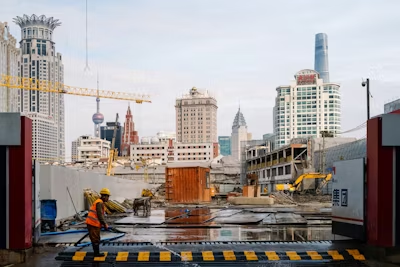
Draw a picture of a construction site that deserves attention.
Thanks to the Internet of Things – essentially, everyday objects made smart with sensors and connectivity – job sites are becoming less chaotic and more connected than ever. It’s not about flashy technology for technology’s sake. It’s about solving real,l everyday headaches that builders have struggled with for decades.
Take tools, for example. How many hours have been wasted looking for the missing drill or waiting for the concrete mixer “somewhere on site”? Now, with tiny IoT trackers connected to equipment, machines,s and even pallets of materials, project managers can see exactly where everything is – on a phone or tablet. No more wild goose hunting. less waste. Less theft. Just smooth, calm days.
Even more powerful is how IoT explores people. Smart helmets and protective jackets can now detect if a worker overheats, suffers a serious fall or enters an area with dangerous gases – and immediately alert supervisors or doctors on site. It’s like a silent guardian keeping an eye on the crew, not a micromanager, but stepping in when it matters most. In an industry where seconds count, that kind of awareness can literally save lives.
And then there are the machines themselves. Instead of waiting for the bulldozer to break down in the middle of the water (and stop the entire schedule), sensors now listen to the engine’s “heartbeat” – recognizing strange vibrations, rising temperatures, or oil problems before they become emergencies. Maintenance takes place during planned breaks, not during times of crisis. Fewer surprises. Less delay. Less stress all around.
In short, IoT transforms the dusty, noisy chaos of a construction site into a smarter, safer, and surprisingly intuitive place—a place where data flows quietly in the background so people can focus on what’s going on . Draw a picture of a construction site that deserves attention.
Take too, for example. How many hours have been wasted looking for the missing drill or waiting for the concrete mixer “somewhere on site”? Now, with tiny IoT trackers connected to equipment, machines, and even pallets of materials, project managers can see exactly where everything is – on a phone or tablet. No more wild goose hunting. less waste. Less theft. Just smooth, calm days.
Even more powerful is how IoT explores people. Smart helmets and protective jackets can now detect if a worker overheats, suffers a serious fall or enters an area with dangerous gases – and immediately alert supervisors or doctors on site. It’s like a silent guardian keeping an eye on the crew, not a micromanager, but stepping in when it matters most. In an industry where seconds count, that kind of awareness can literally save lives.
And then there are the machines themselves. Instead of waiting for the bulldozer to break down in the middle of the water (and stop the entire schedule), sensors now listen to the engine’s “heartbeat” – recognizing strange vibrations, rising temperatures, or oil problems before they become emergencies. Maintenance takes place during planned breaks, not during times of crisis. Fewer surprises. Less delay. Less stress all around.
In short, IoT transforms the dusty, noisy chaos of a construction site into a smarter, safer, and surprisingly intuitive place—a place where data flows quietly in the background so people can focus on what’s going on.
5. Augmented and Virtual Reality (AR/VR): Seeing the Unbuilt
It is not an expensive nightmare. It’s just a few clicks into the model. It’s not just about the spectacular view; It is about security, clear communication, and fewer surprises in the future.
At ground level, augmented reality (AR) is like giving workers superpowers. Imagine a carpenter holding up a tablet and seeing, right on the bare concrete floor, a glowing outline of where every pipe, tube, and electrical conduit will go—like digital chalk that never fades. No more guessing, no more measuring three times and still making a mistake. It’s “x-ray vision” for builders, turning complex plans into something you can see and follow in real time. outcome? Fewer mistakes, less rework and more confidence at work.
And when it comes to safety, VR is changing the game. Instead of learning how to operate a crane or react quickly to a trench collapse, new crew members can practice in a live virtual world – where the effort is zero, but the lessons last. They can make mistakes, ask questions, and build muscle memory without being in danger.
Together, AR and VR don’t replace skilled craftsmen – they give them better eyes, clearer plan,s and safer ways to learn. In an industry built on precision, trust, and teamwork, these tools quietly make the whole process more human: easier to understand, easier.
6. Prefabrication and Modular Construction: Building in a Factory
You might think that building a house means months of mud, noise, and weather delays – but that’s starting to change. Prefabrication and modular construction are not exactly new ideas, but thanks to digital tools such as BIM (Building Information Modeling), they have received a serious upgrade. Now, entire walls, bathrooms, even entire apartment units are built indoors – in clean, climate-controlled factories – and then transported to the site and assembled like high-precision Lego.
And the difference it makes is real. While the foundations are cast on site, trusses, kitchen modules, and bathroom cushions are already taking shape miles away in the factory. No waiting for the rain to stop. No shortage of material at the last minute. This parallel workflow can nearly cut project timelines in half—meaning families move in faster, businesses open faster, and communities get what they need without years of disruption.
Since everything is made in-house under consistent conditions, the quality also gets a huge boost. The screws run straight, the insulation is tight, and every window is perfectly aligned – not because the workers work harder, but because the environment allows them to work smarter. This is craftsmanship, enhanced by sustainability.
What’s more, it’s kinder to the planet. Factories can cut materials with almost zero waste, reuse scrap, and manage resources far more efficiently than the typical dusty site, where the offcuts often end up in dumpsters. The question the world is increasingly asking is: “How can we build better and lighter on Earth?” Modular construction provides a well-thought-out answer.
So what is the construction site now? Perhaps it’s less about chaos and more about coordination – where digital design, factory precision, and efficient on-site assembly come together to build not only faster, but also smarter.
7. Artificial Intelligence and Machine Learning: The Predictive Brain
Think of AI not as a cold, robotic overlord, but as a calm, caring teammate who is always aware. It notices patterns you might forget, wondering “what if?” Helping people make better choices before problems arise and before problems escalate.
In manufacturing—where a surprise storm, delayed shipment, or scheduling error can derail weeks of work—not only is this kind of foresight useful; This is transformative. Today, AI can mine mountains of data: past project timelines, real-time weather, supply chain alerts, and even crew availability. And instead of waiting for chaos to break out, he cautiously raises his hand: “Hey, it looks like the concrete delivery might miss – and it’s going to rain on Thursday. Maybe move the irrigation schedule to Tuesday?” It does not take responsibility. It sharpens human judgment with insight.
During design, AI becomes a creative collaborator. Imagine an engineer saying, “I need something strong, economical, built from local materials, and placed on this steep hill.” Instead of sketching out a few options over coffee, they can ask AI to explore hundreds of options – each stress-tested for cost, structural integrity,y and environmental impact. outcome? Bold, effective designs that would never have been created through traditional methods. It’s like being a tireless collaborator who thrives on complexity and never runs out of ideas.
And out on the side? AI watches – not to monitor, but to support. By reading camera feeds or sensor data from wearables and machines, it can detect workers walking back and forth across the site just to retrieve equipment, or cranes sitting idle for half the day. Then it gestures: “What if we move the shutdown area closer?” Or “Try putting these plates in this order – it could save three hours.” These are not orders. There are smart, practical tips
8. Building a Smarter Future
The construction revolution is not coming – it is already here. And it’s not driven by any flashy gadget or trend, but by an entire ecosystem of technologies working together: smart tools, connected websites, AI insights, and digital design – all weaving together a new way of making.
It opens the door to a new generation – tech-savvy, creative problem solvers who see the workplace not as dusty and dangerous, but as a place of innovation and impact.
Most importantly, how do we meet the urgent need for housing, schools, hospitals, and infrastructure without costing the earth? Because building more doesn’t mean wasting more. With digital tools, we can build smarter, cleaner, and more caring.
The industry that shapes our cities, shelters, and communities is finally reshaping itself. And the plan for the future? It is digital, deeply connected, and alive with intelligence.
The best part? We are just getting started.
How is technology improving safety on construction sites?
Wearable tech, drones, and AI-powered monitoring systems help detect hazards in real time, reducing accidents and enhancing worker safety.
What role does Building Information Modeling (BIM) play in modern construction?
BIM enables detailed 3D planning, improves collaboration among stakeholders, and reduces costly errors by simulating projects before ground is broken.
Can technology help address labor shortages in construction?
Yes—automation, robotics, and off-site prefabrication streamline workflows and reduce reliance on manual labor for repetitive or dangerous tasks.